







Did you know that over 90 percent of new cars use some form of keyless entry system today? Key fobs have become essential tools for safe, effortless access to cars, offices, and secure buildings. These pocket-sized devices go far beyond simple convenience, offering high-level security features and advanced technology. Understanding how key fobs work and what sets old and new models apart can help you make smarter choices about your personal security and daily routines.
Table of Contents
- What Is A Key Fob And Its Purpose
- Types Of Key Fobs And Key Differences
- How Modern Key Fobs Operate Technologically
- Security Features And Common Vulnerabilities
- Costs, Replacement, And Diy Risks
Key Takeaways
| Point | Details |
|---|---|
| Purpose of Key Fobs | Key fobs provide secure and convenient access, enabling keyless entry and enhancing security protocols through RFID technology. |
| Types of Key Fobs | There are three main types: Traditional Remote Keyless Entry Fobs, Proximity Cards/Fobs, and Smart Key Fobs, each serving different access control needs. |
| Security Features | Key fobs use rolling codes and encryption to protect against unauthorized access, but are also vulnerable to signal interception and physical loss. |
| Replacement Considerations | Replacing key fobs can be costly and complex, often requiring professional reprogramming and potentially voiding warranties if attempted DIY. |
What Is a Key Fob and Its Purpose
A key fob is a small, sophisticated electronic device designed to provide secure and convenient access to vehicles, buildings, and restricted areas. According to TechTarget, these compact devices offer “one-factor authentication” that enables keyless entry and significantly enhances security protocols.
At its core, a key fob utilizes advanced radio frequency identification (RFID) technology to communicate wirelessly with secure systems. Webopedia explains that these devices employ symmetric encryption to facilitate contactless unlocking, transforming how we interact with access control mechanisms. By generating unique digital signals, key fobs provide a more intelligent alternative to traditional mechanical keys.
Key fobs typically offer several critical functionalities beyond basic entry:
- Remote vehicle unlocking
- Alarm system activation/deactivation
- Trunk or tailgate release
- Panic button for emergency situations
- Proximity-based automatic access
The primary purpose of a key fob is to simplify security while making access more convenient. Whether you’re approaching your car with groceries or entering a secure workplace, these small devices eliminate the need to manually handle traditional keys, reducing friction in daily access scenarios.
Types of Key Fobs and Key Differences
Key fobs come in several distinct varieties, each designed to meet specific security and access control needs. TechTarget highlights that these devices range from traditional remote keyless entry fobs for vehicles to sophisticated proximity cards for building access, offering a diverse array of technological solutions.
The primary categories of key fobs can be broadly classified into three main types. Webopedia explains that these include:
Here’s a summary of the main types of key fobs and their core differences:
| Type of Key Fob | Typical Use Case | Key Features |
|---|---|---|
| Traditional Remote Keyless Entry Fob | Automotive security | Remote unlock Alarm activation |
| Proximity Card/Fob | Building access | Touchless entry Short-range RF communication |
| Smart Key Fob | Advanced vehicles | Passive entry Remote start Enhanced encryption |
- Traditional Remote Keyless Entry Fobs
- Primarily used in automotive applications
- Allows remote unlocking of vehicles
- Typically includes alarm activation features
- Proximity Cards and Fobs
- Commonly used in corporate and commercial environments
- Enables touchless entry to buildings and secure areas
- Operates through short-range wireless communication
- Smart Key Fobs
- Advanced systems with multiple integrated functions
- Provides passive entry and remote start capabilities
- Incorporates advanced encryption and security protocols
Each type of key fob offers unique advantages depending on the specific use case.
 For those looking to understand more about modern access control technologies, our guide to keyless entry systems provides comprehensive insights into how these innovative devices are transforming security and convenience across various sectors.
How Modern Key Fobs Operate Technologically
Modern key fobs are sophisticated electronic devices that leverage radio frequency identification (RFID) technology to provide seamless access control. TechTarget explains that these devices transmit a unique coded signal to a specialized receiver, enabling complex functions like unlocking doors and starting engines without physical contact.
Webopedia highlights the critical role of symmetric encryption in key fob operations. When activated, these devices send encrypted signals that authenticate and authorize specific actions. The technological process involves several intricate steps:
- Signal Generation: The key fob creates a unique digital code
- Encryption: The code is encrypted for security
- Transmission: A radio frequency signal broadcasts the encrypted code
- Authentication: The receiving device verifies the signal
- Action Execution: Approved commands are implemented
Key fob technology relies on proximity and precise communication protocols. Different frequency ranges enable various functionalities, from short-range building access to longer-range vehicle control. For more in-depth insights into these innovative access technologies, check out our guide to keyless entry systems that explores the evolving landscape of secure, contactless access solutions.
Security Features and Common Vulnerabilities
Key fobs incorporate sophisticated security mechanisms designed to protect against unauthorized access. TechTarget reveals a critical security feature called rolling codes, which dynamically changes the authentication signal with each use, making signal interception significantly more challenging for potential attackers.
Webopedia highlights the potential vulnerabilities inherent in key fob technologies. The primary security risks include:
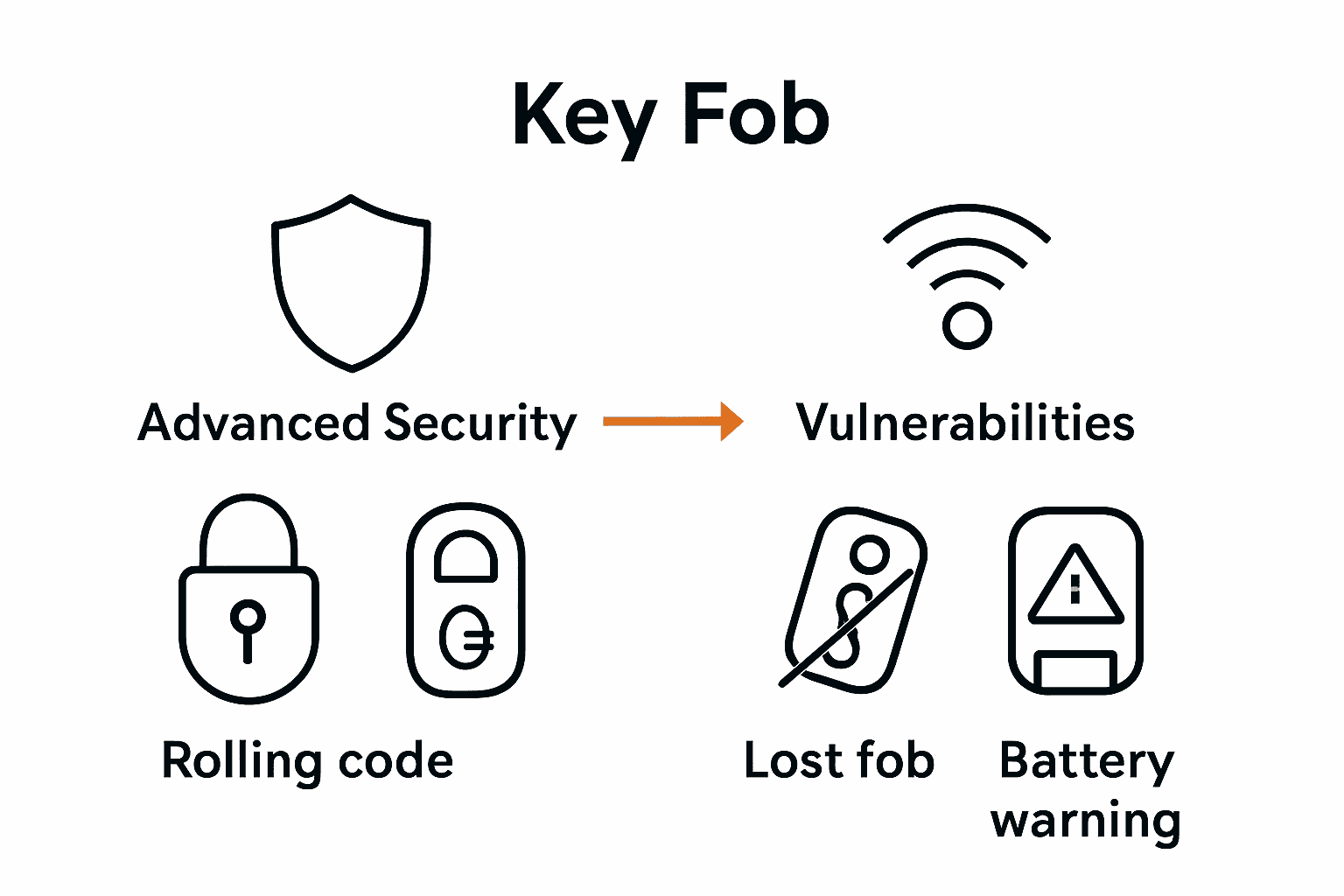
- Signal Interception: Sophisticated attackers can potentially capture and replay key fob signals
- Physical Loss: Misplaced or stolen key fobs can provide unauthorized individuals direct access
- Proximity Attacks: Relay techniques can trick systems into believing the authorized device is present
- Battery Dependence: Low battery levels can compromise signal transmission and security
To mitigate these risks, modern key fob systems employ advanced encryption and multi-layered authentication protocols. Manufacturers continuously develop more robust security measures to stay ahead of potential exploitation techniques. For those concerned about advanced security solutions, our guide to smart lock security offers comprehensive insights into protecting your property against emerging technological threats.
Costs, Replacement, and DIY Risks
Key fob replacement can be a complex and potentially expensive process that requires careful consideration. TechTarget warns that replacing a lost or damaged key fob often necessitates professional reprogramming, which can significantly increase overall costs compared to traditional key duplication.
Webopedia highlights the nuanced risks associated with key fob replacement and DIY attempts. The potential complications include:
- Professional Reprogramming Costs: Ranging from $50 to $400 depending on vehicle and complexity
- Warranty Risks: DIY attempts can potentially void manufacturer warranties
- Technical Complexity: Modern key fobs require specialized electronic synchronization
- Potential System Malfunctions: Incorrect programming may disable vehicle security features
For those seeking to understand the financial implications of key fob replacement, our guide to car key replacement costs provides detailed insights into pricing structures and what to expect during the replacement process. Professional locksmiths recommend consulting experts to ensure accurate, cost-effective key fob replacement that maintains your vehicle’s security integrity.
Secure Your Access with Expert Locksmith Solutions Today
Understanding how key fobs work reveals the importance of advanced security features like rolling codes and encrypted signal transmission to protect your property. If you face challenges such as lost key fobs, concerns about signal interception, or complex reprogramming needs, you deserve trusted support that delivers reliable, professional locksmith services across the Greater Toronto Area.
At My Locksmiths, we specialize in swift and affordable key fob replacement and reprogramming, ensuring your vehicle or building access remains secure without delay. Our licensed technicians understand the intricacies of modern access control systems and provide peace of mind through expert service.

Don’t let a malfunctioning or lost key fob leave you vulnerable. Visit our website now to learn more about our car key replacement services and comprehensive solutions tailored for keyless entry technology. Act quickly to secure your property with trusted professionals ready to respond 24/7. Call or contact us today at My Locksmiths and regain full control over your security.
Frequently Asked Questions
What is the purpose of a key fob?
Key fobs provide secure and convenient access to vehicles and buildings through keyless entry, enhancing security while simplifying daily access.
How do key fobs operate using RFID technology?
Key fobs utilize radio frequency identification (RFID) by transmitting a unique encrypted signal to a receiver, which verifies the signal and allows for actions like unlocking doors or starting engines.
What are the main types of key fobs?
The primary types of key fobs include traditional remote keyless entry fobs, proximity cards/fobs for building access, and smart key fobs for advanced vehicles, each serving different functionalities.
What security features do key fobs have?
Key fobs incorporate rolling codes to prevent signal interception and enhance security, while also employing advanced encryption and multi-layered authentication to protect against unauthorized access.
