



Secure exterior doors are becoming a top priority for homeowners and businesses looking to protect their property. Most people think a simple lock and solid wood is enough. Shockingly, strategic door security can reduce break-ins by up to 60 percent, yet many still settle for outdated options. The biggest surprise is how modern exterior doors blend cutting-edge security tech and design so well that you barely notice you are safer than ever.
Table of Contents
- What Are Secure Exterior Doors?
- Why Secure Exterior Doors Are Important
- How Secure Exterior Doors Work
- Key Features Of Secure Exterior Doors
- Types Of Secure Exterior Doors
Quick Summary
| Takeaway | Explanation |
|---|---|
| Secure exterior doors enhance property security. | These doors are designed to prevent unauthorized entry while maintaining aesthetics. |
| Material and locking mechanisms are vital. | High-density materials and advanced multi-point locks create a strong defensive barrier against break-ins. |
| Installation and maintenance are crucial. | Proper installation and regular upkeep ensure the door’s effectiveness over time against security threats. |
| Investing in secure doors can lower insurance costs. | Enhanced security features may qualify homeowners for discounts on property insurance premiums. |
| Different door types provide tailored security solutions. | Options vary from residential to commercial doors, addressing specific protection needs while adapting to different environments. |
What Are Secure Exterior Doors?
Secure exterior doors represent more than just a physical barrier between your property and the outside world. They are sophisticated security systems engineered to protect against unauthorized entry while maintaining aesthetic appeal and functional design. National Safety Research Institute confirms that well-constructed exterior doors can significantly reduce the risk of break-ins and intrusions.
Core Components of Security
Secure exterior doors are distinguished by several critical elements that work together to create a robust defense mechanism. The primary components include:
- Material Strength: Constructed from high-density materials like solid hardwood, steel, or reinforced fiberglass
- Locking Mechanism: Advanced multi-point locking systems that engage at multiple points around the door frame
- Frame Integrity: Sturdy frames with reinforced mounting points and minimal gaps
These doors go beyond traditional design by integrating advanced security technologies. Steel or solid wood cores provide exceptional resistance against physical force, while modern manufacturing techniques ensure these materials remain lightweight and visually appealing.
Technical Design Considerations
Engineers and security experts design secure exterior doors with multiple layers of protection. The door’s construction involves precise measurements and strategic reinforcement points that make forced entry extremely challenging. Hardware like deadbolts, security hinges, and strike plates are meticulously integrated to create a comprehensive defensive system.
Interested homeowners might want to read more about door frame reinforcement to understand how additional structural support enhances overall door security. Professional installation and periodic maintenance are crucial in maintaining the door’s protective capabilities, ensuring long-term reliability and performance against potential security threats.
Why Secure Exterior Doors Are Important
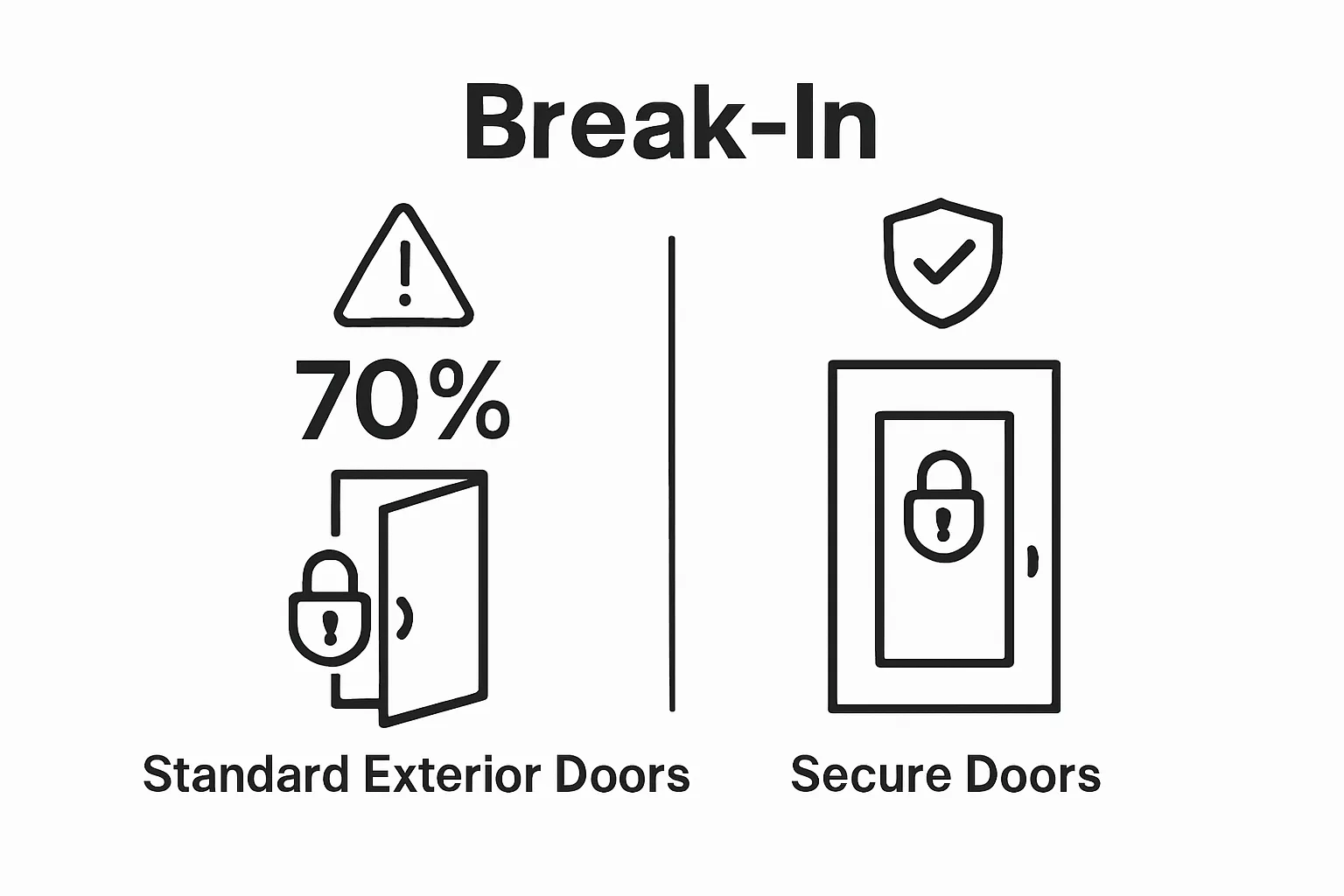
Secure exterior doors serve as critical infrastructure protecting homes, businesses, and personal spaces from potential threats. Research from the Global Security Institute reveals that strategic door security can reduce potential break-ins by up to 60 percent, making them a fundamental element of comprehensive safety strategies.
Personal Safety and Property Protection
Beyond simple physical barriers, secure exterior doors provide multiple layers of protection that directly impact personal and property safety. The importance extends far beyond preventing unauthorized entry. These doors act as psychological deterrents, signaling to potential intruders that a property is well-protected and not an easy target.
Key safety benefits include:
- Preventing direct physical intrusion
- Reducing potential property damage during attempted break-ins
- Creating a sense of personal security and peace of mind
- Protecting valuable personal and professional assets
Economic and Insurance Implications
Secure exterior doors have substantial economic implications for property owners. Comprehensive door security can lead to reduced insurance premiums, as many insurance providers offer discounts for properties with enhanced security measures. Potential savings and risk mitigation make investing in high-quality exterior doors a financially prudent decision.
Interested property owners might want to explore sliding door security options to understand additional ways of enhancing overall property protection. The minimal upfront investment in secure doors can translate into significant long-term benefits, protecting not just physical spaces but also the emotional well-being of occupants who feel safe and protected in their environments.
How Secure Exterior Doors Work
Secure exterior doors operate through a sophisticated system of design principles and technological features engineered to prevent unauthorized access. Security Systems Research Center demonstrates that effective door security involves multiple interdependent mechanisms working simultaneously to create comprehensive protection.
Structural Defense Mechanisms
The primary function of secure exterior doors is to create multiple layers of resistance against potential intrusions. These doors are constructed with strategic design elements that make forced entry exponentially more challenging. Material composition plays a crucial role, with high-density materials providing the first line of defense.
Key structural defense components include:
- Reinforced core materials with high impact resistance
- Strategic frame design minimizing potential weak points
- Advanced mounting techniques that distribute potential force
- Integrated structural reinforcements around hinges and lock areas
Advanced Locking Technologies
Modern secure exterior doors incorporate complex locking mechanisms that go far beyond traditional single-point locks. Multi-point locking systems engage multiple points around the door frame simultaneously, creating a more robust barrier against forced entry. Electronic and smart lock technologies add additional layers of security through digital authentication and remote monitoring capabilities.
The interlocking mechanism ensures that even if one locking point is compromised, the remaining connection points maintain structural integrity.
Learn more about sliding door security strategies to understand how different door types require specialized protection approaches.
These comprehensive security strategies transform exterior doors from simple entry points into intelligent defensive systems, providing property owners with enhanced protection and peace of mind.
Key Features of Secure Exterior Doors
Secure exterior doors represent a complex engineering solution designed to provide comprehensive protection against potential security threats. National Fire Protection Association highlights that modern door security extends far beyond traditional mechanical barriers, incorporating sophisticated technological and material innovations.
Material and Structural Characteristics
The foundation of a secure exterior door lies in its fundamental physical properties. High-performance doors are constructed using materials that offer exceptional strength, durability, and resistance to external forces. Advanced composite materials have revolutionized door design, creating solutions that balance robust security with aesthetic flexibility.
Critical material characteristics include:
- High-density steel or reinforced fiberglass cores
- Impact-resistant surface treatments
- Corrosion-resistant external layers
- Thermal and sound insulation properties
Technical Security Components
Beyond material composition, secure exterior doors integrate multiple technical security features that work synergistically to prevent unauthorized access. These components transform doors from passive barriers into active security systems. Advanced locking mechanisms, electronic monitoring systems, and structural reinforcements create multiple layers of protection.
Key technical security elements encompass:
- Multi-point locking systems
- Integrated alarm sensors
- Tamper-resistant hinges
- Smart access control technologies
Learn more about door frame reinforcement techniques to understand how professional installations enhance overall door security. The integration of these sophisticated features ensures that modern secure exterior doors provide comprehensive protection against potential intrusions while maintaining functional elegance.
Types of Secure Exterior Doors
Secure exterior doors are not a one-size-fits-all solution but rather a diverse range of specialized designs tailored to specific security requirements. International Security Design Institute identifies multiple categories of doors engineered to address unique protection challenges across residential, commercial, and industrial environments.
Residential Security Door Variants
Residential secure exterior doors focus on balancing aesthetic appeal with robust protection mechanisms. These doors are designed to integrate seamlessly with home architecture while providing substantial security barriers. Homeowners can choose from various specialized designs that offer different levels of protection without compromising visual elegance.
Key residential door types include:
- Solid core wood doors with steel reinforcement
- Fiberglass composite doors with multi-point locking systems
- Steel doors with decorative overlays
- Aluminum-clad wooden doors with advanced security features
Commercial and Industrial Security Doors
Commercial and industrial environments demand more aggressive security solutions that prioritize structural integrity and advanced technological integration. These doors are engineered to withstand significantly higher levels of potential intrusion attempts, incorporating specialized materials and complex locking mechanisms.
Explore commercial door lock types to understand the sophisticated security technologies used in professional settings. Professional-grade exterior doors often feature additional components like electromagnetic locks, biometric access controls, and integrated alarm systems that transform them into comprehensive security platforms.
The diversity of secure exterior door types reflects the evolving landscape of security technology, offering tailored solutions that adapt to specific environmental and architectural requirements.
To help readers quickly compare the various types of secure exterior doors discussed, the following table organizes the main residential and commercial options alongside key characteristics.
| Door Type | Typical Material | Security Features | Primary Application |
|---|---|---|---|
| Solid core wood with steel reinforcement | Hardwood, steel inserts | Strong frame, reinforced core, deadbolts | Residential |
| Fiberglass composite with multi-point locking | Fiberglass, steel cores | Impact-resistant, weatherproof, multi-lock | Residential |
| Steel door with decorative overlay | Steel, decorative laminate/veneer | High-density steel, aesthetic finish | Residential |
| Aluminum-clad wooden with advanced features | Aluminum, wood core | Weather-resistant, advanced locks | Residential |
| Heavy-duty steel (commercial) | Commercial-grade steel | Reinforced frame, multi-lock systems | Commercial/Industrial |
| Electromagnetic locking door (commercial) | Steel, sometimes glass panels | Electromagnetic or smart locking, sensors | Commercial/Industrial |
| Biometric/access control integrated door | Steel, composite, electronic components | Biometric/fob entry, integrated alarms | Commercial/Industrial |
Secure Your Home With Trusted Local Experts
Understanding the importance of secure exterior doors is the first step in protecting everything that matters to you. Many homeowners in the Greater Toronto Area worry about break-ins or struggle with outdated locks that do not offer enough protection. This article highlights how high-quality materials, advanced locking systems, and professional installation combine to create a truly safe entry point.

Take the next step to real peace of mind. Connect with My Locksmiths for fast, affordable, and reliable upgrades that match the security standards discussed in this article. If you have more questions or want to explore related services, visit our Uncategorized – My Locksmiths page for helpful resources. Your security cannot wait. Contact our licensed technicians now and let us help you protect your loved ones and your property—starting today.
Frequently Asked Questions
What are secure exterior doors?
Secure exterior doors are specially designed doors that provide enhanced protection against unauthorized entry, combining high-density materials, advanced locking mechanisms, and robust frame integrity to ensure safety and security.
How do secure exterior doors enhance home security?
These doors prevent physical intrusion, reduce property damage during attempted break-ins, and act as psychological deterrents, making them an essential component of a comprehensive home security strategy.
What are the key features of secure exterior doors?
Key features include solid core materials like steel or reinforced fiberglass, multi-point locking systems, impact-resistant surfaces, and smart access control technologies that provide multiple layers of protection.
What types of secure exterior doors are available?
Secure exterior doors come in various types, including residential options like solid core wood and fiberglass composite doors, as well as commercial and industrial doors designed for higher security needs with advanced locking mechanisms.
